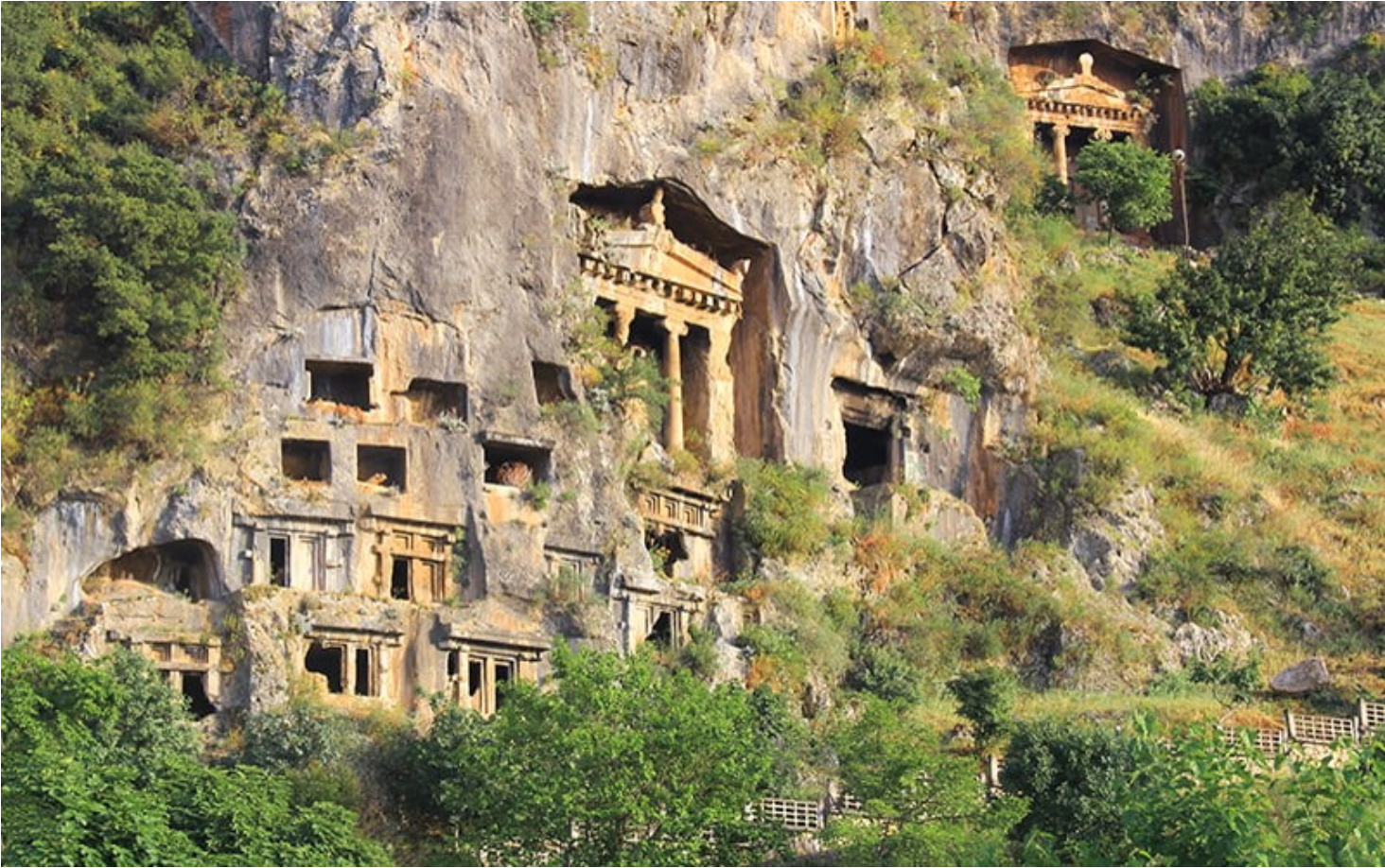
When you look at the steep cliffs overlooking Fethiye from the south, a temple façade carved directly into the rock has been gazing back at you for twenty four hundred years.
In 350 BC, a home was carved into this rock for a Lycian’s final journey. Beside the entrance, a single sentence is inscribed: "Amyntas, son of Hermapias." Nothing else is written. Who he was, or why he was deemed worthy of such a monument, remains unknown perhaps a king, perhaps a nobleman. The locals have simply dubbed it the "King's Tomb."
It features two Ionic columns, a pediment mimicking a temple façade, and a chamber extending deep into the stone. While most of the dozens of surrounding tombs have succumbed to the ravages of time, Amyntas's tomb stands tall as if the stone itself is resisting, determined not to let a name be forgotten.
The French traveler Charles Texier, who visited the site in the 1850s, captured this splendor on paper; those drawings remain key reference points for Lycian archaeology today. The reward awaiting you after climbing the nearly one hundred steps to the tomb is a breathtaking view where Fethiye’s rooftops and the endless blue of the Mediterranean merge into a single frame.
Below, the bustle of modern Fethiye carries on. Above, a name and a stone remain, standing as silent witnesses to humanity's quest for immortality.
Bu mekanı iyi tanıyorsanız yazılı anlatım, ses kaydı,
fotoğraf ve güvenilir kaynaklarınızla katkıda bulunabilirsiniz.
Rehberlik yetkisi her mekan için ayrı değerlendirilir.